 |
 |
 |
Callophyllis pinnata
Red Sea Fan
26 June 2025
Fishboat Bay, Juan de Fuca Strait, B.C., Canada.
Tide: -0.7 foot low at 09:29 PDT (measured at Sheringham Point Tidal Station)
Weather: Overcast, wind variable 5 – 10 km/hour, sea rippled, no swell, humidity 88%, 13 ˚C.
Moon: Waxing Crescent (2.5%, 1 day); Next Phase, First Quarter, 2 July 2025 at 12:30 pm PDT; Previous Phase, New Moon, 25 June 2025 at 3:31 am PDT.
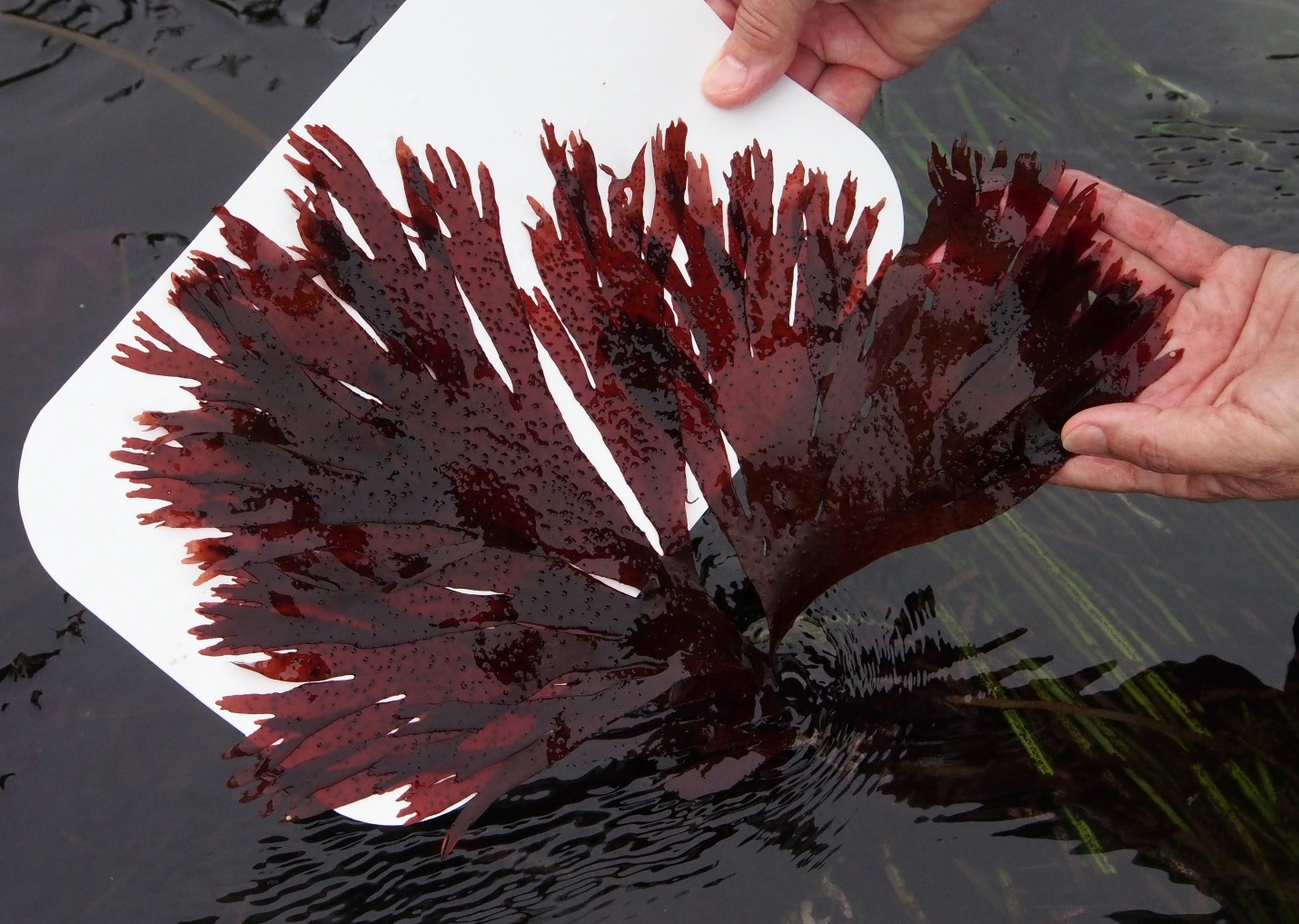
Figure 1: On this minus tide day (-0.7 foot) we found this beautiful Callophyllis pinnata wafting just below the water level. It was growing attached to the stipe of a Prionitis spp. seaweed, and we were fortunate to notice its pattern and color. Red Sea Fan is truly an apt common name. In this photo a contrasting plastic sheet is held behind to help show the morphology of this striking red alga; the hands in the picture give a good estimate of its size. Fishboat Bay, Juan de Fuca Strait, B.C., Canada. June 26, 2025. Photo ID 27846 ©Seaweedwhisperings.com
Person 1:
Gorgeous fans with deep incisions.
Incisions seem well designed, creating no pain for Callophyllis pinnata.
Slightly rough to the feel.
This individual was growing on a Prionitis spp. alga.
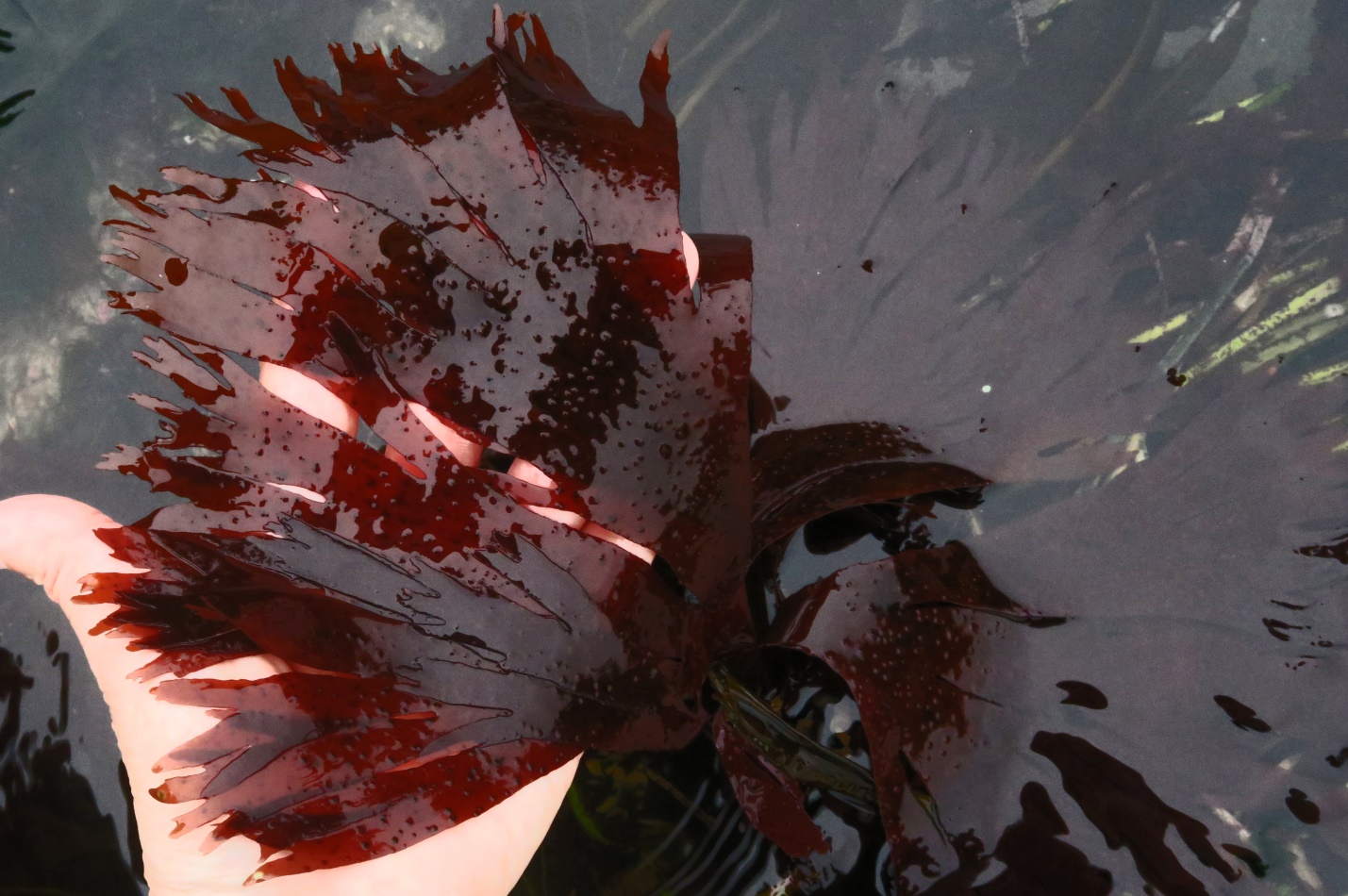
Figure 2: With this photograph the mid-tone contrast has been enhanced to better show the parts of the Red Fans of Callophyllis pinnata that remain underwater. It was impossible to hold the full expanse of these striking blades above water and, in fact, the whole seaweed prefers to be out of sight. The deep cuts between the branches have clean margins and the tips are pointed and the whole feeling of this seaweed is that it is lean, slender but strong, and willful and intent in its focus. Fishboat Bay, Juan de Fuca Strait, B.C., Canada. June 26, 2025. Photo ID 27847 ©Seaweedwhisperings.com
Person 2:
Growing epiphytically on a Prionitis seaweed, we found a beautiful Callophyllis pinnata spreading its dark red fans of narrowly cleft and pointed-tipped blades. It was just submerged at this very, very low summer tide, but was close enough to the surface that we could detect its distinct shape.
The blade is cartilaginous, and very uniform in its thickness, almost perfectly so. The narrow and deep clefts to the blade create what look like groupings of fans with slender, finger-like shapes and pointed looking tips; deeper clefts divide the fans and the result is like a collection of “hands” joined together at their bases/wrists. And covering the whole otherwise smooth surface of both sides of the blade of this seaweed there are numerous small bumps that protrude.
I’m unsure as to the purpose of the bumps that dot the entire surface. They certainly add texture and a point of interest visually. I found it interesting to move my fingers gently over the surface of the blade; my sense of touch was stimulated. Perhaps these bumps are stimulating to Callophyllis, too. Does water move around those bumps like mini localized cyclones? And what does that give Callophyllis that a flat surface would not?
Callophyllis pinnata, you are a flattened deep red fan with pointed fingers to your overall hand or fan-like shape and your surface is textured with small bumps – these features make it easy to confirm your identity in a genus that is very tricky to differentiate to species level. You are a strikingly beautiful seaweed and perhaps your beauty is enhanced because we rarely encounter you.
There is something about your flatness, Callophyllis pinnata – you choose to approach life as a flat fan, and as such you seem to exist most strongly in few dimensions, really only on one plane. And that flat single plane is pretty up front and on display – IF the observer enters Callophyllis’ subtidal realm. This is rather like the expression “a big fish in a small pond” – it is relative; how up front and on display could one really consider this seaweed to be when it chooses to live mainly a quiet life in deeper waters?
You have some cartilaginous toughness to you, Red Sea Fan, so you aren’t limp, but you are also somewhat floppy. Lacking any kind of midrib or flotation devices this seaweed needs something else for that flattened morphology to really work, and I can only conclude that it must be water - being immersed in water gives just the right kind of gentle support for it to interact as it likes with the ocean. Certainly when I was trying to hold parts of this seaweed out of the water for photography it was consistently telling me that it would prefer to return to its submerged position; there it was comfortable, and also when submerged it feels no inconvenience that its design omits the strength or floatation giving structures common to other algae.
I imagined myself flattened out like this and it feels to me that this would allow one to ‘glide’ or sweep or slide or skate or skim through the water. It is at the fullest part of the ‘fans’ – the palms of the ‘hands’ that Callophyllis fully engages this ‘gliding’ movement; out at the ‘fingers’ and especially closer to their tips, at these parts of Callophyllis there can be nuances of movement that are somewhat independent of the glide, or that possibly help sustain the glide. Finger tips might quiver in response to rivulets of current, or flutter lightly when a fish darts past, and from time to time you might even do some larger curls and undulations as you do a “180” and flop over onto your other side when yielding to a strong tidal surge or change of current. Your type of movement feels like it would be gentle and wafting, and not straining or pulling. In fact if hard pulling or tugging were to occur I wonder if you’d harm yourself, Callophyllis. It is also hard to imagine your hand clenched in a fist, Callophyllis.
The possibility of ‘harm’ reminded me of a very early impression noted when I first found this seaweed years ago. The strong red color and the hand with many-fingers shape had me wondering if this was a blood-stained hand. Recalling that I now found myself thinking of just how that might occur. It strikes me that the person with blood on their hands could be the perpetrator of some physically aggressive crime, but where I thought it would be far more commonly seen is with midwives or first aid attendants or emergency care nurses and doctors. When humans are helping other humans such as at childbirth (an exceedingly common and necessary part of life) or after grievous bodily injury such as a traumatic accident (a happening that occurs quite frequently, too) they will get their hands bloodied. They are involved in circumstances where blood has been or will be spilled, and skilled hands are needed to give timely help. Such circumstances require not just a steady hand but also steady resolve and clear intent.
There is something about the shape of this seaweed’s blades that point to traits of being lean yet strong, also adept and capable when motivated by strong intent. This would be a good type of person to have around at times of intense need or emergencies because they can act quickly and deliver skillful and focused assistance. I think also that this kind of person offsets their acts of courageous assistance to those in need with times where they are truly “off duty”. At these times they can even appear to be detached, uninterested (to become involved), or simply resting in an incognito mode. Quite likely there is recovery time needed and so during these off duty times they don’t hide but they also don’t seek to be in any spotlight – a quiet life growing at the base of a strongly anchored perennial kelp would fit the bill quite nicely!
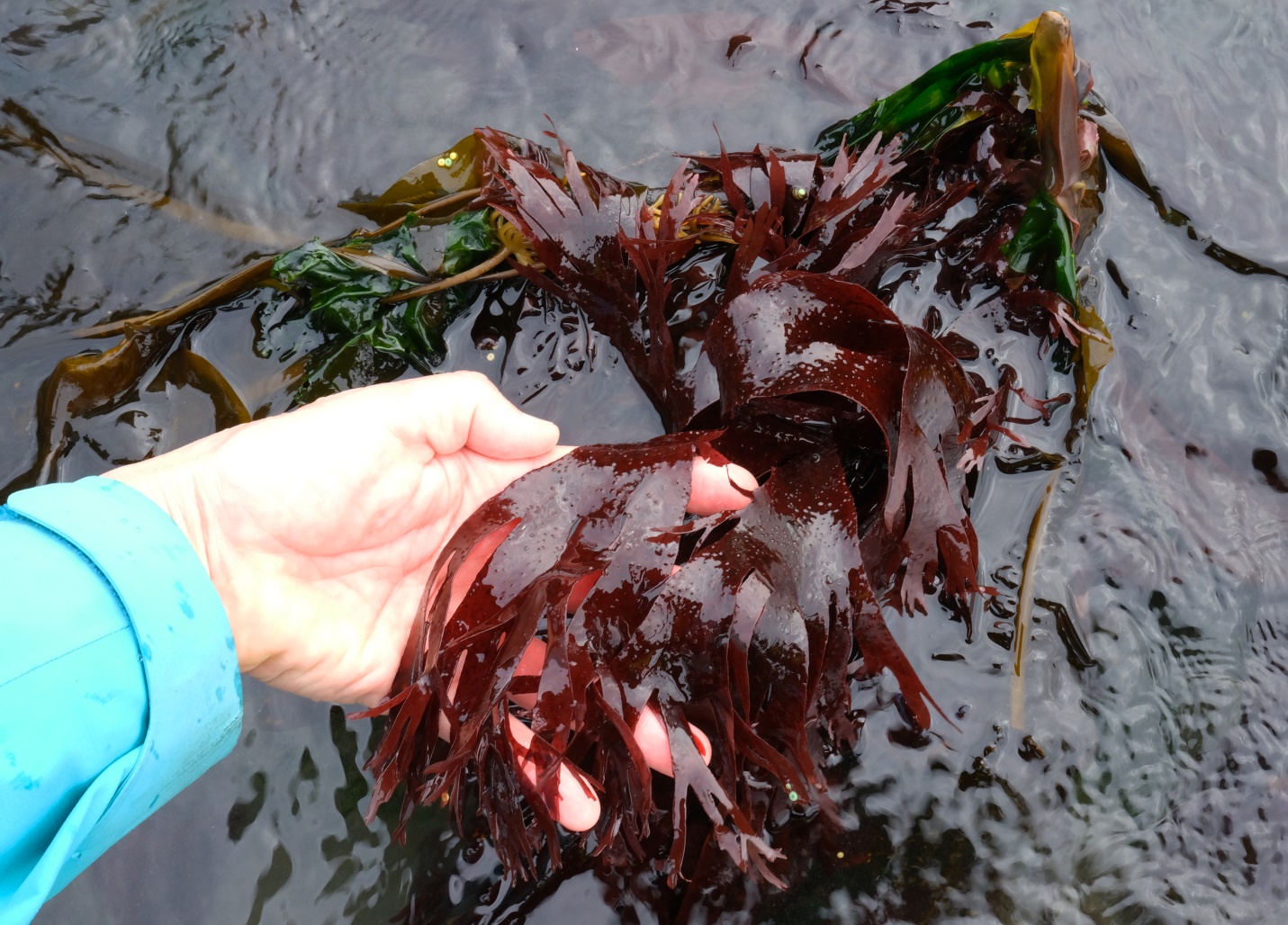
Figure 3: Another very handsome example of Callophyllis pinnata was found a few years earlier at Fishboat Bay; again it was growing epiphytically, this time on the stipe of a kelp individual that was “walked ashore” in high winds. This particular Pterygophora californica kelp had numerous seaweeds growing from its stipe (a common happening for this perennial species) and if you look closely at the top of this photo closer to the water level you will see holdfasts and blades of Alaria marginata and some green Ulva species too. In our area it seems that Callophyllis pinnata prefers a subtidal habitat, so it has been only when ‘the subtidal’ gets pushed into the intertidal - such as occurred with this Walking Kelp, that we find this striking seaweed. Fishboat Bay, Juan de Fuca Strait, B.C., Canada. June 15, 2022. Photo ID 27848 ©Seaweedwhisperings.com
Discussion:
The ‘finger tips’ of this seaweed feel as if they can give it quite a bit of control over its movements, a fine control. Like the wingtip control of a soaring bird, or the ailerons on the wings of an airplane – it gives them excellent control. The control comes in combination with using other forces such as gravity and water movements. The fingers alone aren’t strong; they certainly don’t hold up the blade, but they give the blade some precision of movement.
The tips of this seaweed’s branches are pointed-looking. And the simple observation comes that perhaps they have an ability to point out significant issues. Combining that with their excellent control and precision, maybe Callophyllis can be a bit ‘cutting’ or ‘brutally honest’ with their observations of people and situations. In times where there are true emergencies, and possibly when strategizing in acts of war or conflict (proactive or defensive), this skill is very valuable. This ability could also be very valuable at the testing phase of new inventions, products or treatments. At other times, it may be unpopular to those who are involved with the areas in need of improvements. Callophyllis is accurate in their observations, but they can find themselves in the position of being overruled by management authorities above them; the faults or corrections they have found can be selectively edited out or hidden and this is a source of extreme frustration to Callophyllis pinnata. They have the talent and desire to prove what is true and also what is false – like a true scientist or perhaps a whistle-blower. They do not, however, necessarily have the talent to bring those truths through to the level of policy and action.
When Callophyllis points out something and others can’t hear it, or simply don’t want to hear it, this presents a significant challenge. Callophyllis can then wish to go back to their laboratory or office and continue their careful work, but internally there is really no going back for them. They know what they know and when that is not acknowledged by the people they have shared it with there is a genuine inner conflict. If necessity requires it of them they can reluctantly learn to live with this, but at other times when they have pointed something out those who don’t want to acknowledge the truth of the matter can turn the tables on them. Others can make allegations questioning the work and the integrity of the presenter; this is a type of wound that cuts deeply for Callophyllis, especially since they typically are controlled and precise with their efforts.
Person 1 used the words “deep incisions” in his early observations. It feels that this choice of words, instead of “cleft” or “deeply notched” for example, may have been influenced by the red color of the seaweed (which is even more impressive in real life than in photographs). The definition of “incision” is a mark or decoration cut into a surface; a cut or a gash; a wound made especially in surgery by incising the body. With such cuts, gashes and incisions there is bleeding..., so the red color of blood is quite naturally associated with the word “incision”. We pondered if this seaweed suffers cuts and gashes or other lacerations? It seems that they won’t go looking for situations where they would physically come to harm, but Callophyllis also would not back down from such an encounter if it arose. And we did see how Callophyllis might also be a first responder type of personality; they could be the type to work situations where getting bloodied is a part of the job. Again, they don’t seek this so much as they do have the courage to step up if needed and to not so much ignore the blood, but to not let the blood detract from their purpose and focus. Perhaps this is why Person 1 said the incisions “created no pain” for Callophyllis, because when their willful intentions are pure, they quite possibly are supported by the seaweed equivalent of adrenaline.
There’s also something more about the color, the deep red... it is a dark enough red and so often occurs out of the spotlight such that it can appear almost black; as such the red is hidden or certainly not conspicuous. The overall morphology of this seaweed is actually quite stunning, but we clearly felt that Callophyllis pinnata prefers to be inconspicuous. They struggle with this a bit because they don’t so much want to hide from the world, but if they engage in relationships they seek ones that are deep and true. They’re not into fleeting responses to flashy allure. That is too superficial for them; and if they have shallow day to day interactions they typically are politely reserved. And even though they can show up urgently to be of help in emergencies, in relationships they would like much more time to become acquainted. They do not want to rush things as what they want to find is something deeper and more meaningful to them. A slower approach in these matters is just fine; that is how they understand to build solid and lasting relationships.
After our whispering and while doing research on the biology and natural history of this seaweed, we found that not many of our resources even mentioned this species – far fewer than is often the case for seaweeds in our area. We knew there were excellent drawings in the MAC [Marine Algae of California] and looked those up but oddly couldn’t find the scientific description in this text. So we went to AlgaeBase and downloaded the scientific paper available there. It was a revision of the west North American species of the genus Callophyllis that was published in 1923. This revision was done from a paper that had originally been written in Latin, so…, a translator app was used to give an English translation. In the end it wasn’t a terribly satisfying translation (too many botanical/scientific terms) but we did gain some descriptive information on our species in question. Then the next day, we went back to the MAC – (the book with the elegant botanical drawings) and found what had been hidden to us the day before – the full scientific description of Callophyllis pinnata – published right there, plainly and modestly listed on page 466. This struck us as being so fitting for this seaweed. It can manage to be hidden – in plain sight. And its energy is “modest” – unassuming or moderate in the estimation of one’s self or one’s abilities and achievements.
The botanical drawings in the MAC illustrate two very different forms of Callophyllis pinnata. This encouraged us to go back and review photographs of this species that we have on record when it has been cast ashore by the fall / winter storms in our area. Those specimens hardly resemble the beautiful red pointed tipped fans of summertime at Fishboat Bay. These ones were older, darker red, tougher in texture and the pointed fingers all seem to have been broken away or rounded down by various corrosive forces or possibly by herbivore predation. At that point in the life cycle, it seems this seaweed is inspired to grow new ‘proliferations’ along the margins of the main branches (see Figure 4). These proliferations were found to be mainly located nearer to the base or oldest parts of the blade. The proliferations are ‘distichously’ placed, meaning they are arranged alternately in two opposite vertical rows along the margins of the older parts of the blades.
This old age version of this seaweed has a truly pragmatic and tenacious energy; it’s making the most of what it has to work with and is stripped to essentials. It has comparatively little physical beauty any longer but it has valuable life wisdom nonetheless.
Related to the proliferations, it is as if they want to continue sharing as they age, and will continue to share despite being mostly worn out. This brought to mind an elder, who physically can’t move around much, but you come to the elder and the elder still has much to give.
This brings us back to the hidden and modest and seeking deeper relationship concepts we’d seen for this seaweed. In our times, the wisdom of old age can often be not so respected or valued, certainly not compared to society’s fascination with scientific innovation and other newly developing human undertakings. The wisdom on offer, such as with an elderly Callophyllis, is not actually hidden, it is there in plain sight, however it also is not flashy and often it is not necessarily attractive. But its truths quietly endure. We thought as we interacted with Callophyllis pinnata that there can be such a thing as being too modest – where one actually becomes detached and distant. Possibly elders in various cultures are familiar with this; it must be difficult to know your worth and to also see that you are not “in demand” as an active part of one’s society. This might lead to reticence and a deeper level of silence and separation than would best serve all.
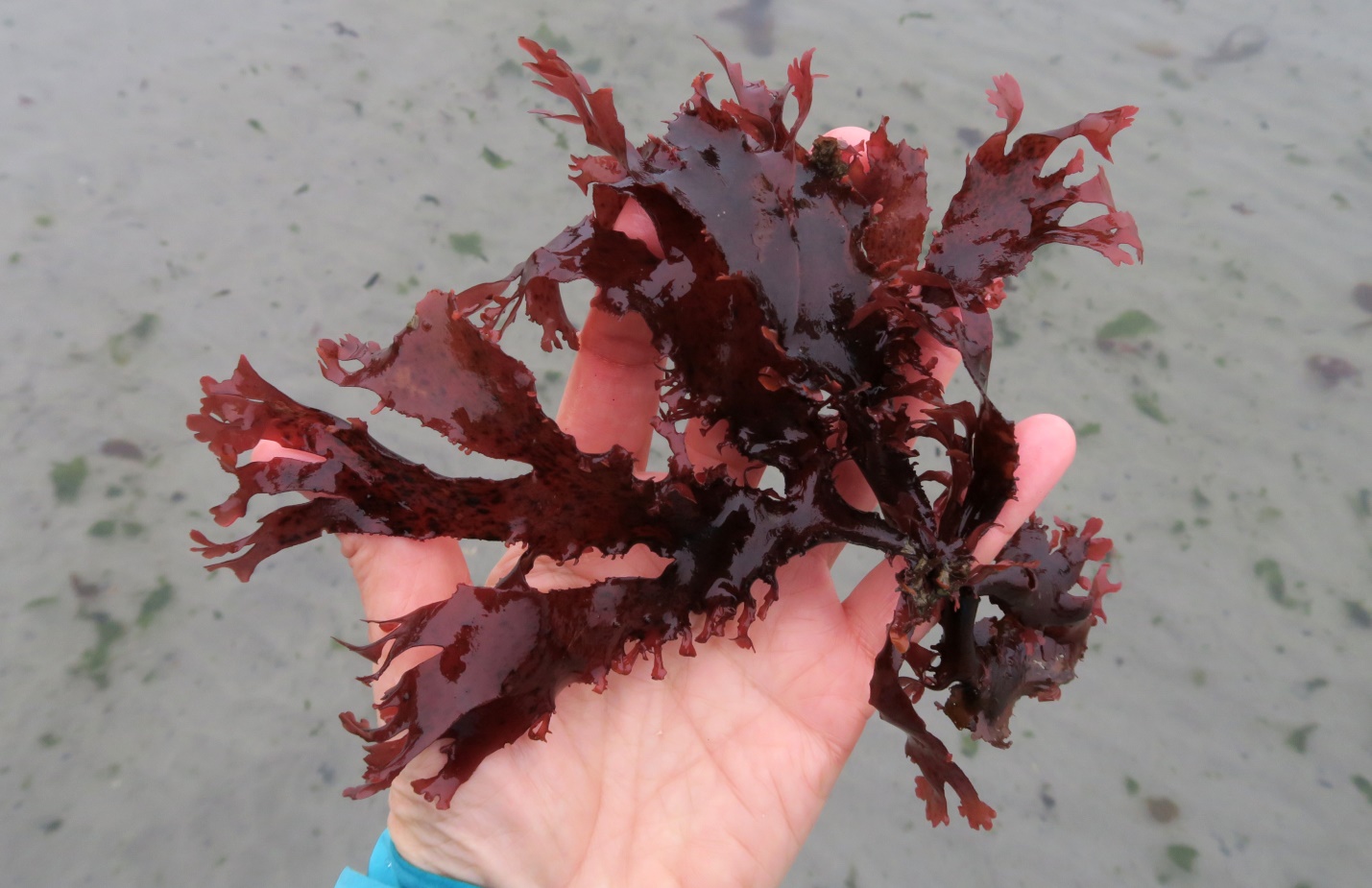
Figure 4: This view shows a tetrasporangial individual with its many ‘proliferations’. The proliferations grow along the margins of the branches and the whole thallus itself is much more loosely and irregularly branched than the many-fingered hand or fan shape depicted in other images. Gonzales Bay, Juan de Fuca Strait, B.C., Canada. November 11, 2021. Photo ID 27849 ©Seaweedwhisperings.com
Biology & Natural History Information:
Description:
Deep rose or red to almost black thallus arising from a discoid holdfast is coarse in texture and shaped like a hand. Cystocarpic plants are mostly palmately flabellately divided with main division 2 – 3 cm wide, 10 – 30 (45) cm long from main dichotomies, branching 4 or 5 times. The ‘hand shape’ is one that is comprised of narrow ‘fingers’ having somewhat pointed tips. Tetrasporangial plants are more loosely and irregularly branched, with older plants having proliferations on margins of main branches. Proliferations are less than 1 cm wide to 8 cm long, distichously placed along margins, rarely occurring on margins of higher-order branches. Tetrasporangia are scattered over the blade and frequently germinating in place; gonimoblasts (spore-bearing filaments) scattered over the blade are less that 2mm in diameter.
Habitat:
Locally abundant, on rocky headlands and epiphytic on kelp stipes. Low intertidal and upper subtidal.
North Pacific Distribution:
Kayak Island, Alaska, to Baja California, Mexico.
Remarks:
The genus name Callophyllis is from the Greek, kallo – beautiful and phyllo – leaf.
Classification:
Empire: Eukaryota
Kingdom: Plantae
Subkingdom: Biliphyta
Infrakingdom: Rhodaria
Phylum: Rhodophyta
Subphylum: Eurhodophytina
Class: Florideophyceae
Subclass: Rhodymeniophycidae
Order: Gigartinales
Family: Kallymeniaceae
Genus: Callophyllis
Species: Callophyllis pinnata Setchell & Swezy 1923
Former name(s): None; there are no synonyms listed for this species in AlgaeBase.
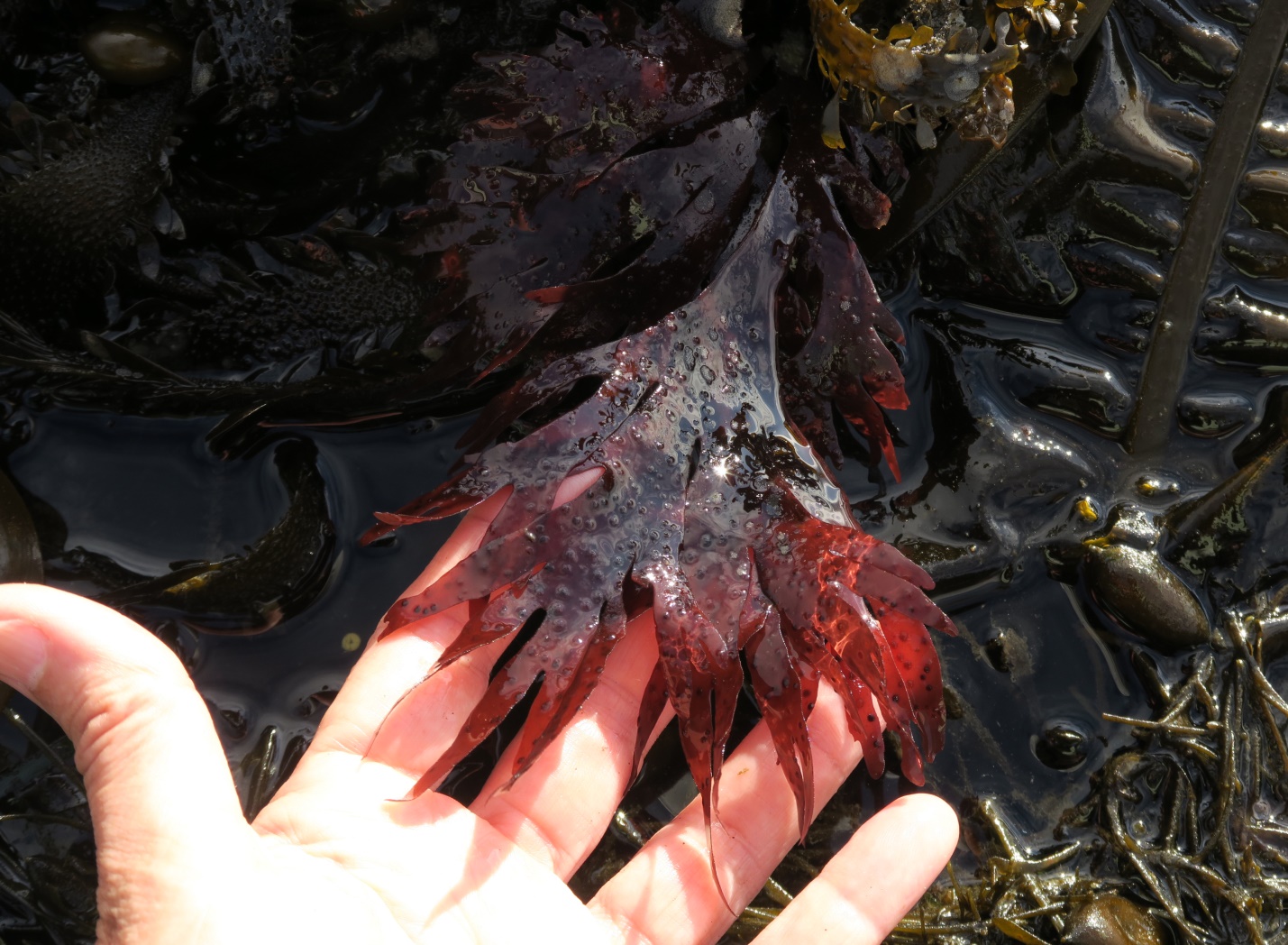
Figure 5: One more example of this striking red alga; it is distinctive enough that it is one of very few seaweeds that have no synonyms – no former names are on record as it seems that its identity has not been questioned since its original description. Fishboat Bay, Juan de Fuca Strait, B.C., Canada. August 18, 2020. Photo ID 27850 ©Seaweedwhisperings.com
